
Mold remediation after water damage means fixing the water source, drying the building, removing materials that mold has grown into, cleaning what is left, and confirming the area stays dry. The EPA says that if wet or damp materials are dried 24 to 48 hours after a leak or spill, in most cases mold will not grow, so the first two days decide whether you have a drying job or a mold job.
Key Takeaways
- The EPA says it is important to dry water-damaged areas and items within 24 to 48 hours to prevent mold growth.
- If the moldy area is less than about 10 square feet, roughly a 3 foot by 3 foot patch, the EPA says in most cases you can handle the job yourself. Larger areas, contaminated water and mold in the HVAC system are not DIY jobs.
- Mold has to be removed, not just killed. The EPA notes that dead mold may still cause allergic reactions in some people.
- HomeAdvisor puts the average mold remediation at $2,368, with a normal range of $1,223 to $3,757 (updated June 19, 2026).
- The Insurance Information Institute says mold is generally treated as a maintenance issue and not covered, unless it is the direct result of a covered peril such as a burst pipe.
How Long Does It Take for Mold to Grow After Water Damage?
Plan around a window of 24 to 48 hours. The EPA’s guidance is built on that number: dry water-damaged areas and items within 24 to 48 hours to prevent mold growth.
Water damage does not always lead to mold. Whether it does depends on how wet the materials got, what they are made of, and how long they stayed wet. The EPA is plain that it is impossible to get rid of all mold spores indoors, and that they will not grow if moisture is not present. Moisture is the part you can control.
Can Mold Grow After Water Extraction?
Yes. Extraction removes standing water, not the moisture left inside materials. The EPA’s guidance for wet carpet and backing lists three steps: remove water with a water extraction vacuum, reduce humidity with a dehumidifier, and accelerate drying with fans, all within 24 to 48 hours. It adds that the subfloor under the carpet or other flooring must also be cleaned and dried.
So a floor that looks dry after extraction is not proof the job is finished. Ask which materials were checked with a moisture meter, and what readings they need to reach before trim goes back on or a wall is closed. Our guide to water extraction covers the equipment and the order of work.
What Are the Signs of Mold After Water Damage?
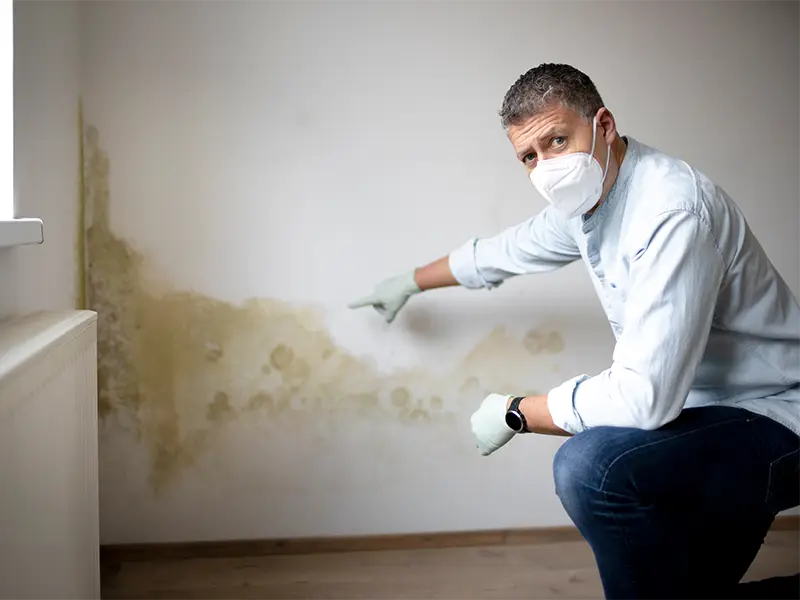
Look and smell for:
- Discoloration, spotting or fuzzy growth on walls, ceilings, baseboards or the underside of furniture
- A musty, earthy odor that does not go away after cleaning
- Paint that bubbles or peels, wallpaper that lifts, drywall that feels soft
- A stain that keeps growing or comes back
The EPA lists the usual hiding places: the back side of drywall, wallpaper or paneling, the top side of ceiling tiles, the underside of carpets and pads, and inside walls around leaking or condensing pipes. If you smell mold but cannot find it, or you know water got into a wall, floor or ceiling, a mold inspection is the safer way to map it. For a stain overhead, see our guide to ceiling water damage repair.
You usually do not need a lab test to act. The EPA says that in most cases, if visible mold growth is present, sampling is unnecessary. The CDC does not recommend mold testing and says you do not need to know the type of mold.
Is Mold From Water Damage Harmful?
It can be, and it affects people differently. The CDC says that for some people mold can cause a stuffy nose, sore throat, coughing or wheezing, burning eyes or skin rash. People with asthma or a mold allergy may have severe reactions, and immune-compromised people and people with chronic lung disease may get lung infections from mold. Keep higher-risk people out of the work area, and if you have health concerns, talk to a health professional before starting any cleanup.
Can You Get Rid of Mold From Water Damage Yourself?
Sometimes. The EPA uses size as the first test. If the moldy area is less than about 10 square feet, roughly a 3 foot by 3 foot patch, in most cases you can handle the job yourself.
Three situations are not DIY jobs at any size:
- Contaminated water. If the water or mold damage was caused by sewage or other contaminated water, the EPA says to call in a professional with experience in buildings damaged by contaminated water. See our sewage cleanup service.
- Mold in the heating and cooling system. The EPA says not to run the HVAC system if you know or suspect it is contaminated with mold, because it could spread mold throughout the building.
- Higher-risk people doing the work. The CDC says people with allergies, immune suppression, underlying lung disease, asthma or COPD should not take part in mold cleanup.
For a small job you do take on, the CDC and EPA agree on the basic protection: at least a NIOSH Approved N95 respirator, protective gloves, and goggles without open vent holes.
Be careful with fans. The EPA and CDC cleanup guide for homeowners says to use fans and dehumidifiers to remove moisture, but not to use fans if mold has already started to grow, because the fans may spread the mold.
How Does Mold Remediation After Water Damage Work, Step by Step?

The steps below follow the EPA’s Mold Remediation in Schools and Commercial Buildings guide, which the EPA says is applicable to other building types.
- Stop the water. Repair the pipe, roof, appliance or drainage problem. If the source is not obvious, leak detection comes first.
- Assess and document. Inspect visible and hidden areas, take moisture readings, and photograph everything before anything is moved or thrown away.
- Contain the work area. The EPA generally recommends limited containment for 10 to 100 square feet of mold: a single layer of 6-mil, fire-retardant polyethylene sheeting, kept under negative pressure so contaminated air does not flow into adjacent areas. For more than 100 square feet it recommends full containment with double layers of polyethylene and an airlock or decontamination chamber.
- Filter the air. Negative pressure is typically created with a HEPA-filtered fan unit exhausted outside the building. The EPA describes a HEPA filter as one that can theoretically remove at least 99.97 percent of airborne particles, including mold, at 0.3 microns.
- Remove what cannot be cleaned. Mold grows into porous materials, and the EPA says it can be difficult or impossible to remove completely from them. Moldy drywall, insulation, carpet and pad are cut out and bagged inside the containment.
- Clean the surfaces that stay. Hard surfaces are scrubbed with detergent and water, then dried completely.
- Dry the structure. Air movers and dehumidifiers run until moisture readings in the framing, subfloor and remaining drywall are back to normal.
- HEPA vacuum and final clean. The EPA recommends HEPA vacuums for the final cleanup of remediation areas.
- Verify, then rebuild. Check that visible mold and moldy odors are gone and the area is dry, then replace insulation, drywall and finishes.
Our mold remediation service follows this sequence, and our water damage restoration crews handle the extraction and drying that come before it.
Should You Use Bleach, Vinegar or Detergent on Mold?
Start with detergent and water. The EPA’s instruction for hard surfaces is to scrub mold off with detergent and water and dry completely. It also says that using a chemical or biocide that kills organisms such as mold, chlorine bleach for example, is not recommended as a routine practice during mold cleanup.
Dead mold may still cause allergic reactions in some people, so the EPA says it is not enough to kill the mold. It must also be removed.
If you do use bleach, the CDC says to use no more than 1 cup of bleach in 1 gallon of water and never to mix bleach with ammonia or any other cleanser. Paint is not a fix either. The EPA says not to paint or caulk moldy surfaces, and that paint applied over them is likely to peel.
What Has to Be Thrown Away After Water Damage?
It depends on the material. The EPA’s table for responding to water damage within 24 to 48 hours gives these actions:
- Ceiling tiles: discard and replace.
- Fiberglass and cellulose insulation: discard and replace.
- Drywall (wallboard): may be dried in place if there is no obvious swelling and the seams are intact. If not, remove, discard and replace, and ventilate the wall cavity if possible.
- Carpet and backing: dry within 24 to 48 hours using a water extraction vacuum, a dehumidifier and fans.
- Upholstered furniture: extract water and speed drying with dehumidifiers, fans or heaters. The EPA notes it may be difficult to dry completely within 48 hours.
Once mold is actually growing, the EPA’s general rule is that absorbent or porous materials, such as ceiling tiles and carpet, may have to be thrown away. EPA guidance is to double-bag unsalvageable moldy materials in 6-mil polyethylene before removal. Those materials can then usually be discarded as ordinary construction waste.
How Much Does Mold Remediation Cost?
According to HomeAdvisor’s mold remediation cost guide (updated June 19, 2026):
- The average mold remediation costs $2,368, with a normal range of $1,223 to $3,757.
- Most jobs land between $10 and $25 per square foot.
- By location, HomeAdvisor lists $500 to $1,000 for a bathroom, $500 to $3,000 for a basement, $500 to $2,000 for a crawl space, $1,000 to $4,000 for an attic, and $3,000 to $10,000 for an HVAC or AC system.
- Professional testing, where it is needed, runs $250 to $800.
These are national figures, not quotes. Price moves with the size of the affected area, how hard it is to reach, and how much drywall, flooring or framing has to be replaced.
Does Homeowners Insurance Cover Mold From Water Damage?
It depends on what caused the water. The Insurance Information Institute says mold, like rot and insect infestation, is a home maintenance issue, and these are generally not covered by standard homeowners insurance policies. However, when mold growth is the direct result of a covered peril such as a burst pipe, the cost of eliminating the mold may be covered. The institute also notes that federal flood insurance may cover mold and mildew damage, but only if it is directly attributable to a flood. The National Association of Insurance Commissioners adds that homeowners policies often exclude the cost of damage from mold, and that floods are not covered by a typical homeowners policy.
Policies differ, so read yours and call your insurer early. To support a claim:
- Report the water damage promptly
- Photograph and video the damage before cleanup, including the source
- Take reasonable steps to stop further damage, such as extracting water and starting drying, and keep the receipts
- Ask your restoration contractor for moisture readings and a written scope of work
How Do You Keep Mold From Coming Back?
Mold returns when moisture returns. The EPA’s prevention advice is specific:
- Keep indoor humidity below 60 percent, ideally between 30 and 50 percent.
- Act quickly on any leak or spill, and dry wet materials within 24 to 48 hours.
- Clean and repair roof gutters regularly, and make sure the ground slopes away from the foundation so water does not collect against it.
- Run the bathroom fan or open a window when showering, and use exhaust fans when cooking or running the dishwasher.
Basements need extra attention after a flood: they are below grade, slow to dry, and often finished with carpet and drywall that hold water. If mold comes back in the same place, the moisture source was not fully fixed.
When Should You Call a Mold Remediation Professional?

- Mold covers more than about 10 square feet, or there has been a lot of water damage
- Materials stayed wet for more than 48 hours before drying started
- The water came from a sewer backup, toilet overflow or outdoor flooding
- You suspect mold inside walls, under flooring, above a ceiling or in the HVAC system
- Someone in the household has asthma, COPD, a mold allergy or a weakened immune system
- You are filing an insurance claim and need the damage documented
When you compare companies, the EPA’s advice is to make sure the contractor has experience cleaning up mold, to check references, and to ask the contractor to follow recognized guidelines, including the EPA’s own remediation guide.
Multi-family, HOA, apartment and hotel properties are commercial work. See our commercial restoration service.
Getting Help With Mold After Water Damage in Denver
Prime Restore Solutions LLC is an IICRC Certified Firm serving Denver and the Front Range, available 24/7. Our team includes a NORMI Certified IAQ/Mold Assessor and Certified Mold Remediator. If you have water damage right now, or mold showing up after a leak or flood, call (720) 790-6056.
Learn more about our mold remediation and mold inspection services, or our Denver damage restoration team.
Frequently Asked Questions
Is it safe to stay in the house during mold remediation?
Often yes, when the work area is contained and under negative pressure, because that is what containment is for. The exception is health. The CDC says people with asthma, COPD or a compromised immune system should not stay in a moldy home, or even be there while it is being cleaned.
Do I need a mold test after water damage?
Usually not if you can see the growth. The EPA says that in most cases sampling is unnecessary when visible mold is present. An inspection is most useful when you smell mold or know water got into a cavity but cannot see the damage.
How do you know the mold is completely gone?
The EPA’s checklist is practical: the water or moisture problem is completely fixed, visible mold and moldy odors are no longer present, a return visit shortly after cleanup shows no water damage or new growth, and people can use the area without health complaints.
Sources
- EPA, CDC, FEMA, HUD and NIH, Homeowner’s and Renter’s Guide to Mold Cleanup After Disasters
- National Association of Insurance Commissioners, Homeowners Insurance
- U.S. Environmental Protection Agency, A Brief Guide to Mold, Moisture and Your Home
- U.S. Environmental Protection Agency, Mold Remediation in Schools and Commercial Buildings Guide, Chapter 3: containment, cleanup methods and disposal
- U.S. Environmental Protection Agency, Mold Remediation in Schools and Commercial Buildings Guide, Table 1: Water Damage Cleanup and Mold Prevention
- U.S. Environmental Protection Agency, What Is a HEPA Filter?
- Centers for Disease Control and Prevention, Mold
- Centers for Disease Control and Prevention, Mold Clean Up Guidelines and Recommendations
- Insurance Information Institute, Protecting Your Home From Mold
- HomeAdvisor, How Much Does Mold Remediation Cost in 2026? (updated June 19, 2026)